Cash or Card in Korea for Tourists: What First-Time Visitors Should Know
5월 21, 2026 | by 코트플
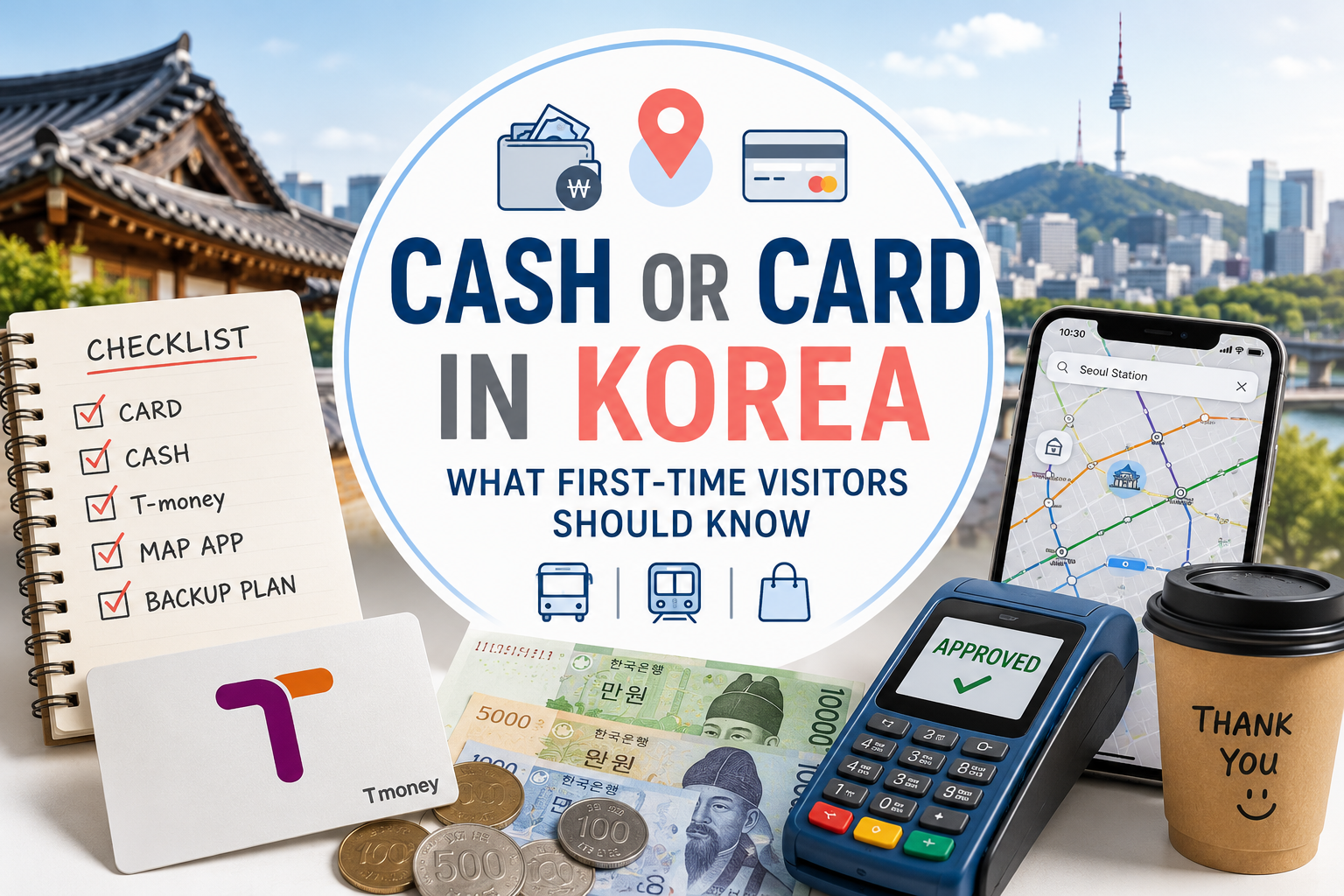
Many first-time visitors wonder whether they should use cash or card in Korea. The short answer is that cards are widely used in Korea, but tourists should still prepare some Korean won in cash for transportation cards, small payments, markets, backup situations, and arrival-day convenience.
Korea is generally a card-friendly country, especially in Seoul, Busan, Jeju, and major tourist areas. However, relying only on one payment method can create problems. A smooth Korea trip usually requires a simple payment setup: one or two international cards, some Korean won in cash, and a T-money card for public transportation.
If this is your first Korea trip, start with our complete first-time Korea travel guide. If you plan to use public transportation, also read our T-money card guide for tourists before arrival.
If you are planning a short trip and want to know how much Korean won to carry, read our How Much Cash Should You Bring to Korea for 5 Days guide.
Quick Answer: Should Tourists Use Cash or Card in Korea?
Tourists can use cards for many payments in Korea, but it is still smart to carry some Korean won in cash. Cards are convenient for hotels, cafes, restaurants, shopping, and larger stores. Cash is useful for charging a T-money card, some markets, small shops, vending machines, emergency backup, and situations where a foreign card may not work.
For many short trips, tourists do not need to carry their full budget in cash. A practical approach is to use cards for larger payments and keep Korean won cash for small, local, or backup situations.
| Payment Method | Best For | Tourist Tip |
|---|---|---|
| Credit card | Hotels, shopping, restaurants, cafes | Bring a backup card in case one card fails |
| Debit card | ATM withdrawals and some payments | Check international fees before traveling |
| Cash | T-money charging, markets, small payments, backup | Carry small Korean won bills, not only large bills |
| T-money card | Subway, buses, and some taxis or small payments | Useful if you use public transportation more than once or twice |
Planning a 5-Day Korea Trip?
For a 5-day Korea trip, many tourists should prepare about 100,000–200,000 KRW in cash as backup. This is not your full travel budget. It is mainly for T-money charging, street food, traditional markets, small shops, and emergencies.
Can Tourists Use Cards in Korea?
Yes, tourists can use credit cards and debit cards in many places in Korea. Hotels, department stores, shopping malls, cafes, restaurants, convenience stores, and many tourist-friendly businesses usually accept card payments.
For many visitors, using a card is the easiest way to pay for larger purchases. It also reduces the need to carry too much cash. However, foreign cards may not work perfectly in every situation, so tourists should avoid relying on only one card.
Card acceptance can vary by business, machine, card issuer, network, and payment terminal. A card that works at a hotel may not always work at a small shop, local machine, or transportation-related payment point.
Where Cards Are Commonly Used
- Hotels and guesthouses
- Restaurants and cafes
- Convenience stores
- Department stores and shopping malls
- Beauty stores and clothing shops
- Museums, attractions, and ticket counters
- Some taxis and larger transportation services
Better Card Setup for Tourists
- Bring at least two cards if possible
- Use cards from different networks if available
- Check foreign transaction fees before departure
- Tell your bank you are traveling if your bank requires it
- Keep one backup card separate from your wallet
Do You Need Cash in Korea?
You do not need to pay for everything in cash in Korea, but carrying some cash is still useful. Many tourists can use cards most of the time, especially in Seoul. However, cash can solve small problems that cards cannot.
The most common reason tourists need cash is transportation card charging. A T-money card can make subway and bus travel easier, but charging the card may require cash depending on where you charge it.
Cash is also useful for markets, small local stores, street food, coin lockers, older vending machines, emergency backup, and situations where your foreign card does not work.
If you want a simple cash-only estimate for a short itinerary, see our How Much Cash Should You Bring to Korea for 5 Days guide.
Where Cash Can Be Useful
| Situation | Why Cash Helps | Tourist Advice |
|---|---|---|
| Charging T-money | Some charging methods are easier with Korean won cash | Keep small bills ready after arrival |
| Markets and street food | Some small sellers may prefer or require cash | Carry small bills, not only large bills |
| Emergency backup | Foreign cards can fail unexpectedly | Keep some cash separate from your main wallet |
| Small machines or lockers | Some machines may not accept foreign cards | Check payment options before relying on them |
How Much Cash Should Tourists Carry in Korea?
The right amount of cash depends on your travel style, trip length, and payment habits. You do not need to carry a large amount of cash every day, but having a modest amount of Korean won can make your trip easier.
For first-time visitors, it is practical to prepare enough cash for transportation card charging, small snacks, markets, backup taxi situations, and unexpected payment problems.
For a 5-day trip, many tourists can prepare around 100,000–200,000 KRW in cash and use cards for most larger payments. For a more detailed breakdown by travel style, read our 5-day Korea cash guide.
Instead of carrying all your cash at once, keep a small amount in your wallet and store backup cash separately in your hotel or luggage. This reduces risk if your wallet is lost.
Practical Tip
Do not arrive in Korea with only one foreign card and no cash. Even if cards work most of the time, having some Korean won gives you a safer backup during your first day.
Credit Card vs Debit Card in Korea
Both credit cards and debit cards can be useful in Korea, but they work differently depending on your bank, card network, and international payment settings.
A credit card is often convenient for hotels, shopping, restaurants, and reservations. A debit card can be useful for ATM withdrawals, but international fees and ATM availability should be checked before traveling.
Credit Card Advantages
- Convenient for hotels and larger purchases
- Useful for shopping, restaurants, and cafes
- May include travel benefits depending on your card
- Good backup for unexpected expenses
Debit Card Advantages
- Can be useful for ATM withdrawals
- Helps control spending
- Can work for some card payments
- Useful as a backup if your credit card fails
What to Check Before Traveling
- Foreign transaction fees
- ATM withdrawal fees
- Daily withdrawal limits
- International card usage settings
- Whether your bank blocks unusual overseas transactions
T-money and Transportation Payments in Korea
A common mistake is thinking that a regular credit card is enough for all transportation in Korea. While some payment options may work in some situations, most first-time tourists find it easier to use a T-money card for public transportation.
A T-money card is a rechargeable transportation card used for subways, buses, and some other payments. It is especially useful in Seoul and other major cities.
If you plan to ride subways or buses several times, a T-money card can save time and make transfers smoother. For detailed instructions, read our complete T-money card guide for tourists.
Why T-money Is Useful
- No need to buy a single-use subway ticket every time
- Easy subway and bus transfers
- Useful for short city travel
- Convenient for first-time visitors using public transportation
Payment Tip for T-money
Prepare some Korean won in cash for charging your T-money card. Depending on the charging location and machine, cash may be the easiest or required method.
Airport Arrival Payment Tips
Your first payment decisions often happen at the airport. You may need mobile internet, transportation, snacks, a transportation card, or a taxi. If you are tired after a long flight, payment confusion can make arrival more stressful.
Before landing in Korea, prepare your airport transfer plan. If you are arriving through Incheon Airport, compare AREX, airport bus, taxi, and private transfer in our Incheon Airport to Seoul transportation guide.
Before Arrival, Prepare These
- One main payment card
- One backup card
- Some Korean won cash
- Your hotel address
- Your airport transfer method
- Mobile internet plan
- T-money card plan if using public transportation
Arrival-Day Payment Mistake
Do not wait until after landing to figure out all payment methods. The airport is manageable, but you may be tired, carrying luggage, and trying to find transportation at the same time. Preparing in advance makes the first day much easier.
Restaurants, Cafes, Shops, and Markets
In Seoul and major cities, cards are usually convenient for restaurants, cafes, shopping malls, convenience stores, and beauty stores. However, markets and smaller local places may be more variable.
If you plan to visit traditional markets, street food areas, small shops, or local neighborhoods, carry some cash. Even if cards are accepted, cash can be faster and easier for small payments.
Payment by Place
| Place | Card Use | Cash Tip |
|---|---|---|
| Hotels | Usually card-friendly | Keep a backup card for check-in issues |
| Cafes and restaurants | Usually card-friendly in major areas | Cash can help if a foreign card fails |
| Convenience stores | Usually card-friendly | Useful for small backup purchases |
| Traditional markets | Varies by seller | Carry small cash bills |
| Street food | Varies | Cash can be more convenient |
Can Tourists Use Mobile Payments in Korea?
Mobile payments are common in Korea, but tourists should not rely on local mobile payment systems unless they have confirmed that their app, card, and phone setup work in Korea.
Some international mobile wallets or contactless cards may work in certain places, but acceptance can vary. For first-time visitors, the safest setup is still simple: physical card, backup card, some cash, and a T-money card for transportation.
Better Approach
- Do not rely only on mobile payment
- Carry a physical card
- Keep some Korean won cash
- Prepare T-money for public transportation
- Check payment options before depending on one method
Where to Exchange Money or Withdraw Cash
Tourists can usually exchange money before departure, at the airport, or in major city areas. Some travelers also withdraw cash from ATMs using an international debit card. The best option depends on your home bank fees, exchange rates, travel schedule, and comfort level.
For convenience, it can be useful to arrive with at least some Korean won. This helps with your first transportation, snacks, small purchases, or T-money charging.
Cash Preparation Tips
- Do not carry all your cash in one place
- Prepare some small bills
- Check ATM fees before using your card
- Keep emergency cash separate from your daily wallet
- Do not wait until the last minute if you need cash for transport
Common Payment Mistakes Tourists Make in Korea
Most payment problems in Korea are easy to avoid with a little preparation. The most common mistake is relying on only one payment method.
1. Bringing Only One Card
If your only card is blocked, declined, lost, or not accepted by a specific terminal, you may have a stressful situation. Bring a backup card if possible.
2. Not Carrying Any Cash
Even in a card-friendly country, cash is useful for transportation card charging, markets, street food, and backup situations.
For a short trip, check a practical cash range before arrival. Our 5-day Korea cash guide explains how much Korean won tourists may want to prepare.
3. Not Preparing T-money
If you use subways and buses, a T-money card makes transportation much easier. Do not wait until you are already confused at a busy station.
4. Assuming Every Foreign Card Works Everywhere
A foreign card may work in many places, but not every machine or terminal will accept every card. Always have a backup.
5. Forgetting About International Fees
Your home bank may charge foreign transaction fees or ATM withdrawal fees. Check this before traveling.
6. Keeping All Cash and Cards in One Wallet
If you lose your wallet, losing every payment method at once can be a serious problem. Keep one backup card or some emergency cash separate.
Recommended Payment Setup for First-Time Visitors
For most first-time visitors, the best Korea payment setup is simple and practical.
| Item | Why You Need It | Priority |
|---|---|---|
| Main credit card | Hotels, restaurants, cafes, shopping | High |
| Backup card | If your main card fails or is lost | High |
| Korean won cash | T-money charging, markets, backup payments | High |
| T-money card | Subway and bus travel | High if using public transport |
| Mobile payment | Convenient where accepted | Optional |
Payment Tips by Travel Style
Your best payment setup can change depending on your travel style.
If You Are Staying Mostly in Seoul
Cards will likely be convenient for many payments. Still, carry cash for T-money charging, markets, street food, and backup situations.
If You Are Visiting Markets or Local Areas
Cash becomes more useful. Some sellers may prefer cash, and smaller purchases can be easier with Korean won.
If You Are Traveling with Family
Bring more than one payment method. Family travel often includes larger meals, taxis, attractions, and unexpected expenses.
If You Are Arriving Late at Night
Prepare payment methods before landing. Late arrival can make it harder to solve card or cash problems calmly.
If You Are Using Public Transportation
Prepare a T-money card and some cash for charging. This is one of the simplest ways to avoid transportation stress.
Final Recommendation
For most tourists, Korea is card-friendly, but it is not smart to travel with only one payment method. The best setup is a main card, a backup card, some Korean won in cash, and a T-money card if you plan to use public transportation.
Use cards for hotels, restaurants, cafes, shopping, and larger payments. Use cash for T-money charging, markets, street food, small payments, and backup situations. Keep your payment setup simple, but do not rely on only one option.
If you are planning a 5-day Korea trip, many tourists should prepare around 100,000–200,000 KRW in cash as backup. For a focused breakdown, read our How Much Cash Should You Bring to Korea for 5 Days guide.
If you prepare your payment methods before arrival, your first day in Korea will feel much easier. Airport transfer, subway rides, food, shopping, and small emergencies are all less stressful when you have both card and cash options ready.
Planning Your First Korea Trip?
Start with these beginner-friendly Korea travel guides before your trip.
- How Much Cash Should You Bring to Korea for 5 Days
- How Much Money to Bring to Korea
- First Time in Korea: Complete Travel Guide for Beginners
- Where to Stay in Seoul for First-Time Visitors
- How to Get from Incheon Airport to Seoul
- How to Use T-money Card in Korea
- Best Korea Travel Apps for Tourists
- Seoul 3-Day Itinerary for First-Time Visitors
- Common Mistakes First-Time Visitors Make in Korea
FAQ
Can tourists use credit cards in Korea?
Yes, tourists can use credit cards in many places in Korea, especially hotels, restaurants, cafes, convenience stores, department stores, and shopping areas. However, it is still smart to carry some cash as a backup.
Do I need cash in Korea as a tourist?
You do not need cash for every payment, but you should carry some Korean won. Cash is useful for T-money card charging, markets, street food, small shops, and backup situations.
How much cash should I bring to Korea for 5 days?
For a 5-day Korea trip, many tourists should prepare about 100,000–200,000 KRW in cash as backup. This is mainly for T-money charging, street food, markets, small shops, and emergencies.
Is Korea card-friendly?
Yes, Korea is generally card-friendly, especially in major cities and tourist areas. However, card acceptance can vary by business, machine, terminal, and foreign card type.
How much cash should I bring to Korea?
The right amount depends on your trip length and travel style. Most tourists should carry enough cash for transportation card charging, small purchases, markets, and emergencies, while using cards for larger payments.
Can I use a debit card in Korea?
Some debit cards can work in Korea for payments or ATM withdrawals, but it depends on your bank and card network. Check international fees, limits, and overseas usage settings before traveling.
Can I use T-money instead of cash or card?
T-money is mainly useful for public transportation such as subways and buses. It does not replace a credit card or cash for all travel payments, so tourists should still carry other payment methods.
Do I need cash to charge a T-money card?
Cash is often the easiest way to charge a T-money card, especially at subway station machines or some convenience stores. Prepare some Korean won for transportation card charging.
Are mobile payments easy for tourists in Korea?
Mobile payments can be convenient where accepted, but tourists should not rely only on mobile payment. A physical card, backup card, cash, and T-money card are safer for first-time visitors.
Can I use cards at Korean markets?
Some market sellers may accept cards, but others may prefer cash. If you plan to visit traditional markets or street food areas, carrying small cash bills is recommended.
What is the safest payment setup for a first Korea trip?
The safest setup is one main card, one backup card, some Korean won in cash, and a T-money card for public transportation. Keep backup cash or a backup card separate from your main wallet.
“`RELATED POSTS
View all